

Last Updated: May 18, 2026
By: Brian Karr · Co-Founder & Chief Inspection Officer, We Inspect
Chronic fatigue that persists despite rest, sleep improvement, or medical treatment usually has a continuous environmental source that has never been identified. The most overlooked cause is mycotoxin exposure from mold growing inside water-damaged walls, floors, or HVAC systems. That exposure continues every hour you spend in the building, regardless of how well you manage everything else.
Persistent fatigue of this kind is clinically distinct from ordinary tiredness. It doesn’t resolve with sleep, worsens over months or years, and frequently co-occurs with cognitive symptoms, immune disruption, and body pain that also fail to respond to standard interventions. When the cause is environmental, the fatigue continues because the source of exposure continues.
Key Takeaways
- Fatigue that doesn’t improve with rest may be driven by an ongoing environmental exposure, not a sleep disorder or stress response.
- A 2013 study in Toxins found that 93% of patients diagnosed with chronic fatigue syndrome tested positive for mycotoxins in their urine, with over 90% reporting a history of water-damaged building exposure.1
- Recovery requires identifying and removing the source. Managing symptoms alone cannot produce lasting results while the exposure continues.
Why fatigue that “never goes away” doesn’t respond to the usual fixes
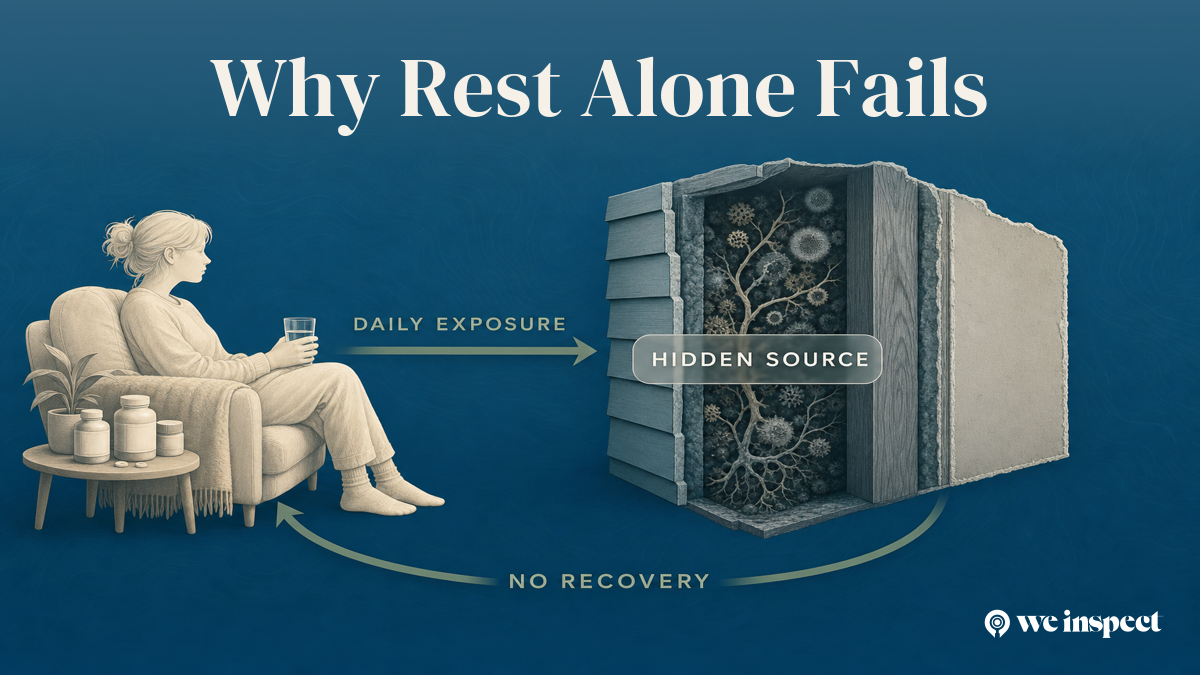
Most people with unresolved fatigue have already worked through the standard options: sleep optimization, thyroid panels, adrenal support, dietary changes, stress reduction. When none of them hold, the explanation is usually direct. They address symptoms while the underlying cause remains fully active.
I hear a version of this almost every week. A man in Phoenix told me last month he’d been dealing with bone-deep exhaustion for two and a half years, had cycled through a sleep specialist and a cardiologist, and his labs kept coming back normal. He felt noticeably better during a 10-day trip out of state. He was worse again within days of coming home. That’s the pattern that matters.
If mold is growing inside a wall cavity or within an HVAC system, everyone in that building is breathing mycotoxins continuously. No sleep protocol interrupts that cycle. A 2003 study in TheScientificWorldJOURNAL found that patients with chronic toxigenic mold exposure had significantly suppressed natural killer (NK) cell activity — the immune cells responsible for first-line defense against pathogens and cellular threats.2 Chronic fatigue was the most common clinical complaint in this population, and it persisted as long as the exposure continued.
Fatigue that worsens at home and improves during extended time away is a significant indicator that the building is the variable. Not lifestyle, not fitness, not disease progression. The building.

How mold and mycotoxins create fatigue that standard workups don’t find
In 2013, a study in the journal Toxins examined 112 patients diagnosed with chronic fatigue syndrome.1 Ninety-three percent tested positive for at least one mycotoxin in urine. Trichothecenes, the mycotoxins produced by Stachybotrys and related mold species, were detected in 58% of cases. More than 90% had a documented history of exposure to water-damaged buildings. This established a direct clinical link between a CFS diagnosis and a measurable mycotoxin body burden.
The mechanism matters. Mycotoxins interfere with mitochondrial ATP production, disrupting the cellular machinery responsible for generating the body’s primary energy currency. When that process is impaired, no amount of rest corrects it. The impairment is happening at the cellular level, not the behavioral one.3
Standard diagnostic workups for chronic fatigue don’t include environmental assessment. Physicians diagnose disease; they don’t inspect buildings. Without a source-level evaluation of the home, the question of what is causing the fatigue cannot be fully answered. The patient continues in the same building, with the same exposure, wondering why nothing works.
The Centers for Disease Control and Prevention estimates that between 836,000 and 2.5 million Americans have ME/CFS, and that up to 91% remain undiagnosed.4 Environmental exposure as a driver is rarely screened for in that population. For many of them, that’s the gap.

Next Steps
If you want to know what your home is actually doing to your body, we can find out. We Inspect uncovers hidden mold contamination, ranks what truly drives your exposure, and delivers a contractor-ready Remediation Recovery Blueprint designed to meaningfully reduce exposure so your body can heal — without wasting tens of thousands on unnecessary fixes that won’t move the needle. Get My Free Exposure Consultation
Frequently Asked Questions
Can mold actually cause chronic fatigue that doesn’t go away?
Yes. Mold produces mycotoxins that suppress immune function and disrupt mitochondrial energy production at the cellular level. In a 2013 study, 93% of CFS patients tested positive for mycotoxins in urine, with documented water-damaged building exposure in over 90% of those cases. Fatigue driven by ongoing mold exposure doesn’t resolve until the source is identified and removed.
How do I know if my chronic fatigue is caused by mold versus something else?
A key indicator is location-based variation: fatigue that worsens at home and improves during extended time away is a strong signal that the building environment is a factor. Other indicators include fatigue that began after a known water event, visible mold or persistent musty odors, and symptoms that don’t respond to any standard treatment. Source-level exposure mapping is the only way to confirm or rule out the home as a cause.
What does “source-level” evaluation mean for fatigue and mold?
Source-level sampling identifies where mold is actively growing inside the building — inside walls, under flooring, in HVAC cavities — not just what’s floating in the air. This is distinct from dust sampling, which measures what you’re already breathing in occupied spaces. Both have roles, but finding the source is the necessary first step for understanding whether an active exposure is occurring and where it originates.
References
- Brewer JH, Thrasher JD, Straus DC, Madison RA, Hooper D. Detection of mycotoxins in patients with chronic fatigue syndrome. Toxins. 2013;5(4):605-617. doi:10.3390/toxins5040605
- Anyanwu EC, Campbell AW, Ehiri JE, Akpan AI, Jones J. The neurological significance of abnormal natural killer cell activity in chronic toxigenic mold exposures. TheScientificWorldJOURNAL. 2003;3:1928-1936. doi:10.1100/tsw.2003.98
- Shoemaker RC, House DE. Sick building syndrome (SBS) and exposure to water-damaged buildings: time series study, clinical trial and mechanisms. Neurotoxicology and Teratology. 2006;28(5):573-588. doi:10.1016/j.ntt.2006.07.011
- Centers for Disease Control and Prevention. Myalgic encephalomyelitis/chronic fatigue syndrome (ME/CFS): basic facts. Published 2021. cdc.gov/me-cfs

This article is for informational purposes only and does not constitute professional medical advice. If you believe mold or other environmental hazards may be affecting your health, consult your healthcare provider.